
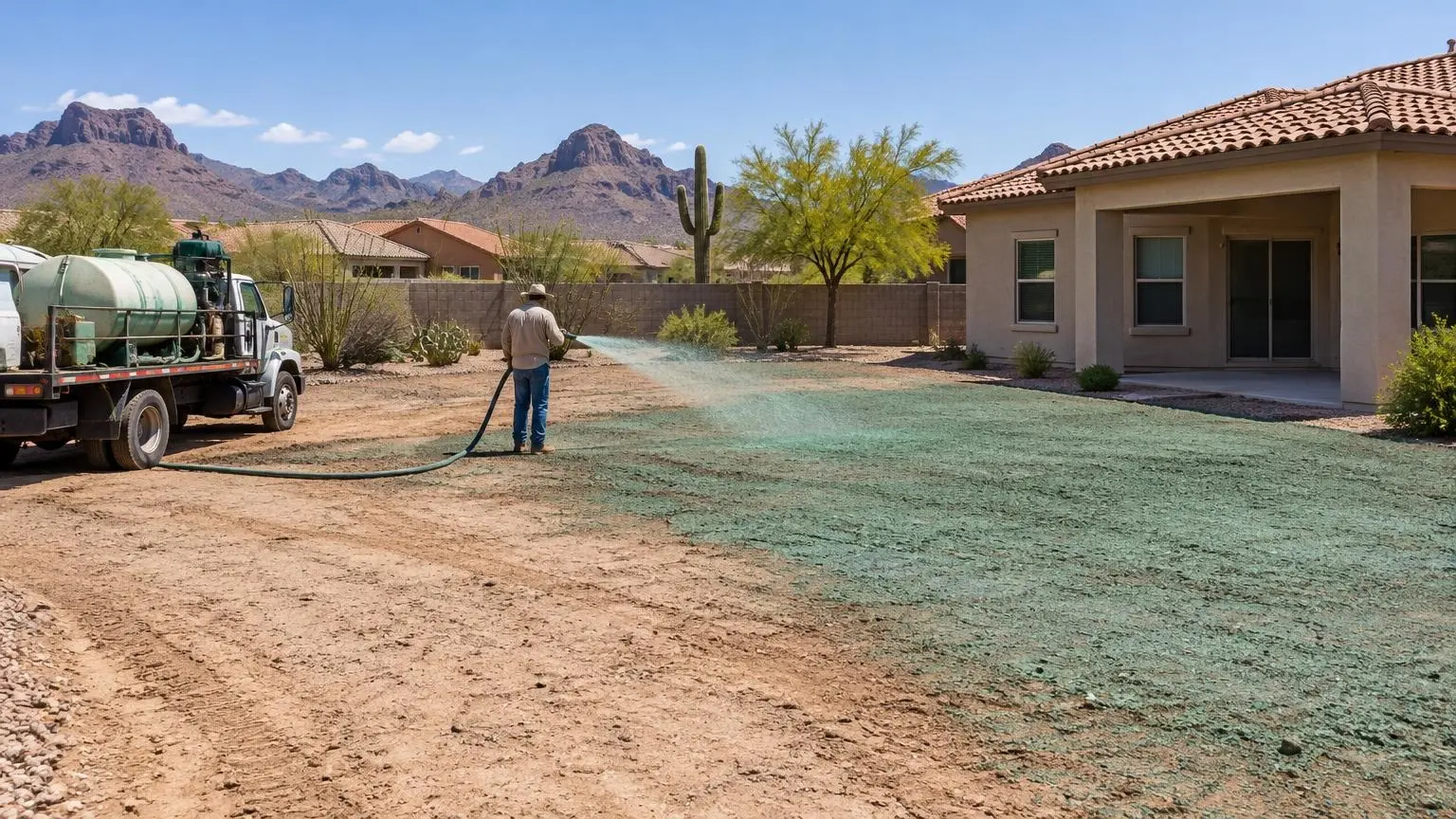
Seed, mulch and water, timed for the desert
Hydroseeding in Phoenix, AZ
New lawns, builder lots and desert slopes seeded around the heat, the monsoon and a 7-inch rain year.
- We look at your lot at no charge and quote it in writing
- Seed picked for the season: bermuda in summer, ryegrass in fall, natives for desert ground
- A written watering plan with every new seeding
Grass in the Sonoran Desert Starts With Timing
Hydroseeding in Phoenix works differently than it does almost anywhere else in the country. The city sits at a mean elevation of 1,086 feet in the northern reaches of the Sonoran Desert, and Sky Harbor's long-term average is just 7.22 inches of rain a year. Nothing we spray here sprouts on rainfall alone. What hydroseeding does well in the Valley is lay down seed, fertilizer, a tackifier and wood fiber mulch in a single pass, one even layer that holds moisture against the soil, so irrigation goes further and seed is not blown or washed off the grade. We use it for new bermuda lawns, winter rye, builder and commercial lots, retention basins, wash banks and native desert revegetation.
What the valley floor is made of
Away from the mountains, Phoenix is generally flat, which is why the streets run on such a clean grid. Much of that flat ground is old alluvium laid down by fans and streams. The USDA describes the Mohall series, typed in Maricopa County, as a coarse sandy loam surface over a calcic horizon that begins 20 to 40 inches deep, with moderately slow permeability and slopes of 0 to 8 percent. In plain terms: the top drains well enough, but a lime-rich layer below can slow water, and graded lots are often compacted hard. Before any lawn installation we check how fast water soaks in, loosen compacted subgrade, and bring in topsoil where a builder's cut has left bare subsoil at the surface.
Heat, frost and the seeding calendar
Phoenix averages about 111 days a year at 100 degrees or more, most days from late May through late September, and it rarely drops to freezing. That flips the usual seeding calendar. University of Arizona Cooperative Extension calls bermudagrass the turf best adapted to the low desert and lists May through August as the months to plant it from seed, with a seeded lawn taking about a month to establish. Ryegrass is the winter grass: the same extension guide puts winter seeding at October 10 to November 10 around Phoenix, and notes the average first frost arrives in mid-November. Hybrid bermudas are sterile and can only go in as sod or sprigs, so a seeded lawn means common bermuda.
Sod, hydroseed or dry seed
Sod gives you a finished bermuda lawn the day it is laid, and Extension lists sodding from May into September. It also costs the most: in HomeGuide's numbers, laid sod is $1 to $4 per square foot, against $0.12 to $0.35 for hydroseeding. Dry seed broadcast by hand or spreader is cheapest, but on bare desert ground in June it dries out and blows around before it can root. The hydroseed lawn sits in between: the mulch layer shades the seed, holds water between irrigation cycles, and the tackifier keeps it in place in wind. University of Nebraska Extension describes the trade the same way: hydroseeding runs slightly above dry seeding in price but usually below sod.
Hydro seeding vs a landscaper with a spreader
Many landscape crews offer grass seeding with a broadcast spreader and a rake. That can work in a small, shaded yard. On a full lot in open sun, the difference is the mulch. Hydro seeding lays the seed inside a damp fiber blanket instead of on top of bare sandy loam, which matters in a place where 87 percent of possible sunshine is the yearly average.
The monsoon, washes and stormwater
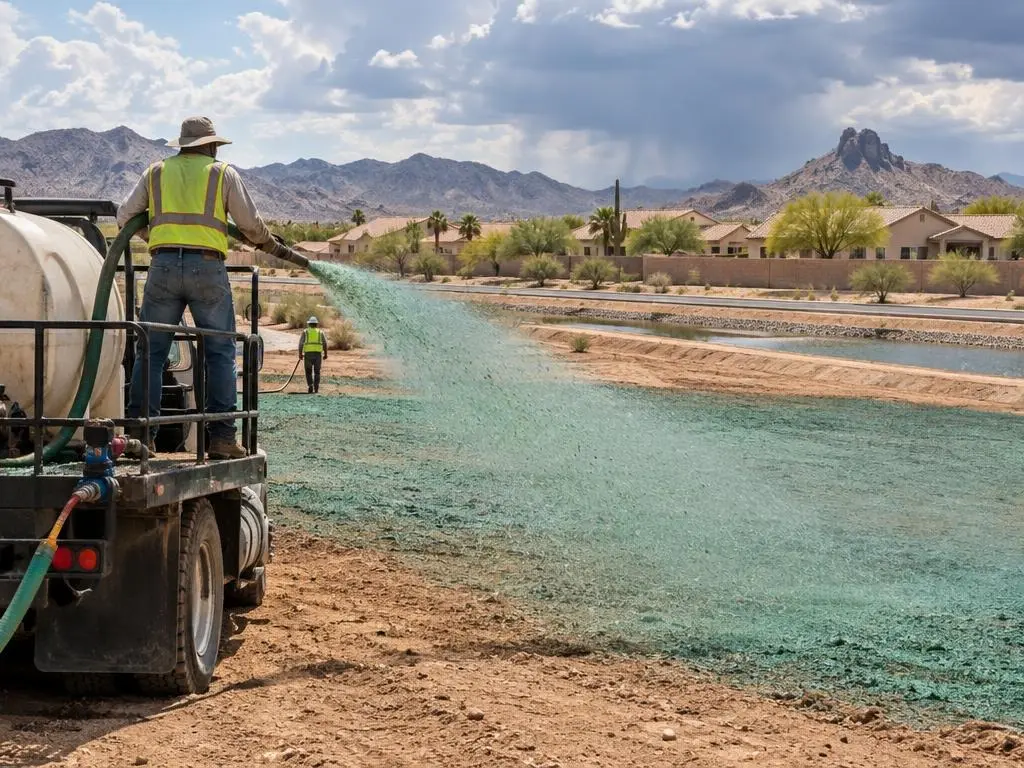
Since 2008 the National Weather Service has treated June 15 through September 30 as Phoenix's monsoon season. When it is active it brings heavy localized rain, flash floods, destructive winds and dust storms that can grow into a haboob. July and August average close to an inch of rain each at Sky Harbor, often in one or two storms. For a freshly graded lot that means sheet flow across bare dirt and sediment headed for the street. This is where erosion control, silt fence, inlet protection and slope stabilization come in, and where we change the mix: heavier hydromulch or bonded fiber matrix on banks, erosion control blankets in swales, and fiber rolls or silt fence below disturbed ground.
Permits that shape the job
The City of Phoenix requires a grading permit for most grading, filling or excavating, with narrow exceptions for shallow work, and the exceptions stop applying once land disturbance goes over one acre. Arizona requires construction general permit coverage, with a stormwater pollution prevention plan, once a site disturbs an acre or more, and also for smaller parcels that belong to a bigger planned development. Most single-family lawn jobs fall under both thresholds. Builder lots, commercial pads and subdivisions usually do not, and their SWPPP will list exactly which erosion control and sediment control measures go where. We install to that plan.
Dust and disturbed ground
Phoenix has high particulate pollution at times, and the city's own Wikipedia entry notes that PM10 dust from storms and from disturbed construction or farm sites is linked to Valley Fever. Bare graded dirt that sits all summer is a dust source and an erosion problem. Hydroseeding or hydromulching it, even with a temporary cover, stabilizes the surface until landscaping or a permanent seed mix goes in.
How much water a lawn really takes
It helps to know the numbers before you decide how big the grass area should be. University of Arizona Extension's maintenance guide, using AZMET data for the Phoenix area, puts an established bermuda lawn's needs at about 5.2 inches of water in April, 6.3 to 6.7 inches a month from May through August, and 3.6 inches in October. A dormant, non-overseeded bermuda lawn needs little or nothing in winter beyond a monthly soak if the rains fail. A ryegrass winter lawn needs roughly half an inch to an inch and a half a week from November to May. Valley water-conservation groups make the point plainly: a small, well-watered lawn is a reasonable part of a desert yard, and wall-to-wall turf is not. Some cities in the area even offer rebates to replace grass with desert plants. We are happy to seed a play lawn for the kids and dogs and put native seed or rock on the rest.
How a seeding job runs
- Site visit: soil, slope, irrigation coverage and drainage checked
- Written estimate spelling out which grass or native mix, which mulch, and any blankets or silt fence
- Grading and soil prep: rip compacted ground, fine grade, add topsoil if needed
- Hydroseed or hydromulch application from the truck or hose
- Watering schedule left with you, adjusted for the month
- Follow-up advice on first mow, fertilizing and, for bermuda, skipping winter rye the first year
Our Services
Six kinds of seeding and soil work, from a backyard bermuda lawn to a basin slope on a new subdivision.
Bermuda Lawn Hydroseeding
New bermuda lawns sprayed in the warm months, plus winter rye overseeding and repair of thin lawns.
Learn more →Builder & Commercial Hydroseeding
Large-area hydroseeding for subdivisions, commercial pads, basins, schools and parks.
Learn more →Slope & Wash Erosion Control
Erosion blankets, hydromulch and bonded fiber matrix to hold banks, basins, swales and washes.
Learn more →Silt Fence & Inlet Protection
Silt fence installation, inlet protection, fiber rolls and sediment control for builders and permitted sites.
Learn more →Grading, Topsoil & Dirt Work
Yard grading, land grading, topsoil and the dirt work that gets a site ready for seed.
Learn more →Native Desert & Wildflower Seeding
Sonoran Desert native and wildflower seed mixes for open space, washes, slopes and low-water yards.
Learn more →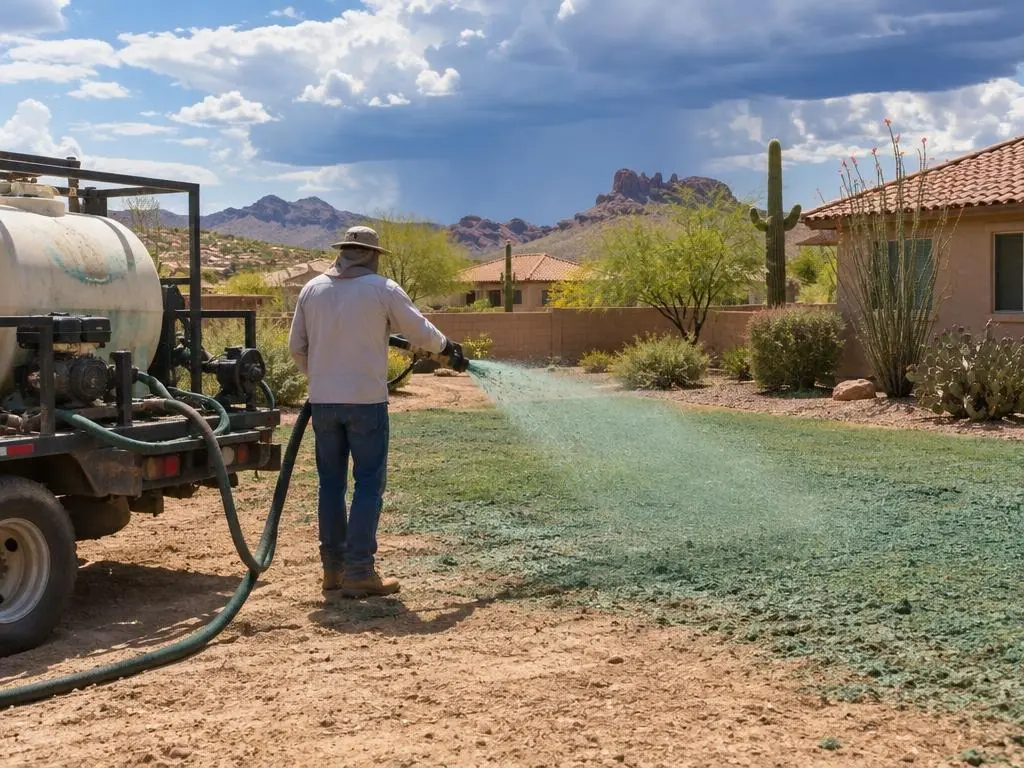
Common Questions
How much does a hydroseed job cost in Phoenix?
Published consumer guides span about $0.07 to $0.35 a square foot for a home lawn, and HomeGuide's figure for 5,000 square feet of lawn is $1,000 to $1,750. Most hydroseeding companies also have a minimum job fee, which HomeGuide puts at $300 to $500 or more. Soil prep, grading, slope and access change the number, so we price your Phoenix lawn after seeing it and put that price in writing before any work starts.
Is hydroseeding worth the money?
For a bermuda lawn larger than a small patch, usually yes. It costs a fraction of sod, and the mulch layer holds moisture and resists wind far better than dry seed on bare desert ground. If you need the lawn usable within a week, sod is the better buy.
What are the disadvantages of hydroseeding?
You wait. A seeded bermuda lawn takes about a month to establish, it needs several short waterings a day at first, and it should stay off-limits to heavy play until it fills in. It also only works in the right season: bermuda seed sown in winter will sit dormant.
Can I hydroseed my own lawn?
Small rental and bagged hydroseed kits exist, and they can work on a patch. On a full yard the hard parts are the prep, getting an even application rate, and the watering in Phoenix heat. New seedings here usually fail from compacted soil or a missed watering on a hot afternoon, not from the spray itself.
Which months work for seeding a Phoenix lawn, bermuda or winter rye?
For a permanent bermuda lawn, plant from May through August, when University of Arizona Extension lists seeding. For a green winter lawn of ryegrass, the extension window for Phoenix is October 10 to November 10. Spring and early fall are transition periods when neither grass establishes well from seed.
Should I overseed a new bermuda lawn with winter rye this year?
Extension advises against overseeding a new bermuda lawn in its first winter. The young bermuda has to green up and regrow in spring while competing with vigorous ryegrass. Let it go dormant and blonde the first winter.
How long until I can mow a hydroseeded lawn?
Under good conditions seed sprouts within about a week, and cost guides put the first mow at roughly four to six weeks. In Phoenix summer heat bermuda moves quickly once it is up; we tell you what height to look for.
Do I need a permit for hydroseeding?
Seeding itself, no. The grading before it can need one: Phoenix requires a grading permit for most grading and filling beyond shallow work, and any site disturbing an acre or more needs state construction stormwater coverage. A typical backyard lawn is under both thresholds.
Why Homeowners Call Hydroseeding Phoenix
Seeding by the desert calendar
Bermuda goes down in the warm months and winter rye in the October to November window Extension recommends, so you are not paying to seed the wrong grass at the wrong time.
Soil checked before seed
Graded lots in the Valley are often compacted, and some sit over lime-rich subsoil. We look at infiltration and prep before we spray.
Erosion work in the same crew
Silt fence, blankets, hydromulch and grading are handled together, so a builder lot or basin is stabilized in one plan.
A watering plan in writing
Seed fails in Phoenix from too little water in June and too much in December. You get a schedule written for your month and your irrigation.
Across the Valley, Canal Lots to Foothills
We work in Phoenix and across the Valley. On the east side that includes Scottsdale, Paradise Valley, Fountain Hills, Tempe, Mesa, Gilbert, Chandler, Queen Creek, San Tan Valley and Apache Junction, where former farm ground sits next to foothill lots off the McDowells and the Superstitions. On the west side we cover Glendale, Peoria, Surprise, El Mirage, Litchfield Park, Avondale, Goodyear and Buckeye, where new subdivisions are still being carved out of raw desert and old cotton land along the Agua Fria and Gila. To the north, Cave Creek, Carefree and Anthem sit higher, get more rain and lean toward native seed and wash stabilization. South of the Gila, Maricopa is flat and very dry in early summer. Pick a town below for its own soil, water and slope notes, from river-bottom ground to hillside cuts.
- Hydroseeding in Phoenix, AZ
- Hydroseeding in Scottsdale, AZ
- Hydroseeding in Mesa, AZ
- Hydroseeding in Chandler, AZ
- Hydroseeding in Gilbert, AZ
- Hydroseeding in Tempe, AZ
- Hydroseeding in Glendale, AZ
- Hydroseeding in Peoria, AZ
- Hydroseeding in Surprise, AZ
- Hydroseeding in Goodyear, AZ
- Hydroseeding in Avondale, AZ
- Hydroseeding in Buckeye, AZ
- Hydroseeding in Queen Creek, AZ
- Hydroseeding in San Tan Valley, AZ
- Hydroseeding in Maricopa, AZ
- Hydroseeding in Apache Junction, AZ
- Hydroseeding in Fountain Hills, AZ
- Hydroseeding in Paradise Valley, AZ
- Hydroseeding in Cave Creek, AZ
- Hydroseeding in Carefree, AZ
- Hydroseeding in Anthem, AZ
- Hydroseeding in El Mirage, AZ
- Hydroseeding in Litchfield Park, AZ
Book a Free Site Visit
Tell us what you want growing and when. We will check the ground and send a written estimate.